
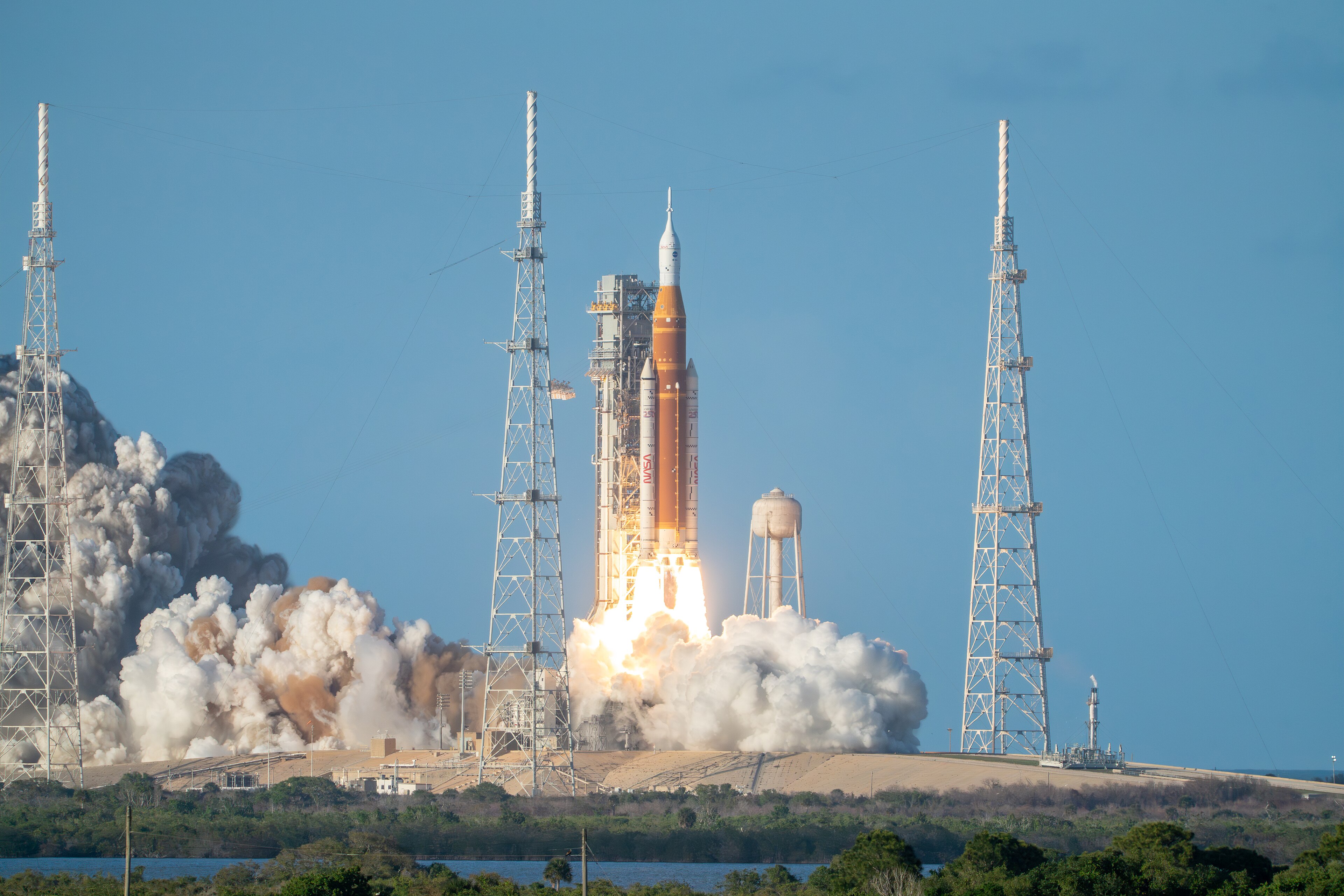
Spaceweather.com reports that NASA's Artemis II mission left a giant ionospheric disturbance, labeled there as a "plasma contrail," stretching more than 3,100 miles across North America after the April 1, 2026, launch toward the Moon.
According to Spaceweather.com, authors led by National Cheng Kung University researcher Jong-Min Choi describe the trail as the first report of such elongated disturbances generated during a spacecraft launch. Choi and colleagues' paper, including coauthors from National Cheng Kung University alongside NASA Goddard Space Flight Center, has been accepted for publication in Geophysical Research Letters, Spaceweather.com reports. The site says the Artemis II upper stage fired its engine for 18 minutes inside the ionosphere, a layer of Earth's atmosphere ionized by solar radiation, and that pressure from the hot exhaust shoved local plasma aside along the flight path. The manuscript identifies that burn as the upper stage's Apogee Raise Maneuver.
Choi's team found the signature in data from 3,500 GPS stations across the Americas, Spaceweather.com says, with the disturbance affecting signals at hundreds of those stations. A day later, when the Orion crew capsule fired its own engine toward the Moon, a second streak about half as long appeared over the same region, according to the site.